Panopticon: The Design and Evaluation of a Game that Teaches Data Science Students Designing Privacy
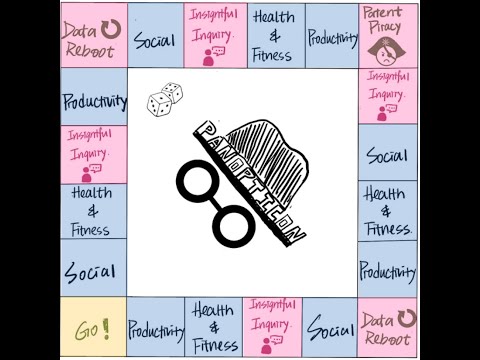
Panopticon is an educational board game that teaches data science students how to design privacy-sensitive data practices through interactive gameplay. Drawing inspiration from Monopoly, this game reimagines financial systems as a data economy where players alternate between being digital service users and developers.
- Game Overview
- Game Materials
- Setup Instructions
- Facilitation Tips
- Video Tutorials
- Frequently Asked Questions
- Citation
Drawing inspiration from Monopoly, Panopticon reimagines financial systems as a data economy where players alternate between being digital service users and developers. In this game, players navigate a game board, claiming digital services by iteratively creating privacy designs, critiquing others' designs, and revising their own based on peer feedback.
- Data Points: Function as currency; developers spend them to enter the market and earn them when users access their services
- Trust Scores: Measure privacy design quality; decrease when users identify privacy concerns through critiques
- Critiques and Inquiries: Players learn by critiquing and inquiring others' designs and receiving feedback on their own
This repository contains all materials needed to play Panopticon:
- Game Board: PDF (A3 preferred, or 2 A4 sheets connected)
- Game Rules: PDF | Markdown
- Design Worksheet: PDF
- Task Bank: PDF | Markdown
File Formats
- PDF Files: Ready for printing without modifications
- Markdown Files: Editable versions if you wish to customize or expand on the materials
- Print the Game Board: Ideally on A3 paper. If unavailable, print on two A4 sheets and put them together.
- Print Design Worksheets: One per player.
- Prepare Task Bank: Print or have digital access to the task scenarios.
- Gather Supplies:
- Dice (1-2)
- Player tokens (3-4 game pieces that represent each player as they move around the game board)
- Whiteboard or papers and pens for each player
- Timer
- Assign a Teacher/Facilitator: One person should act as the judge who scores critiques.
Before starting, walk players through:
- The game board layout and different types of spaces
- How to use the design worksheet
- Critique scoring criteria (specificity, justifiability, and actionability)
Hand each player:
- A design worksheet
- Paper for notes
- A game piece
- 1,000 data points
- Familiarize yourself with the scoring criteria for critiques before starting
- Encourage specific, actionable feedback rather than vague criticism
- Keep the game moving at a good pace to maintain engagement
- Allocate appropriate time limits for design creation (2 minutes) and revisions (1 minute)
- Focus on collabrative learning rather than winning
- Be constructive in your critiques
- Use the worksheet structure to organize your thoughts
To help with the game setup and guide you through the design worksheet, we have recorded a tutorial video. You can watch it here or click the thumbnail below:
Q: How many players can participate?
A: Panopticon works best with 3-4 players, but can be adapted for 2 players or larger groups divided into teams.
Q: How long does a game session take?
A: A typical session lasts 40-60 minutes. It can be extended or shortened based on learning objectives.
Q: Do players need prior knowledge of privacy concepts?
A: Basic familiarity with privacy concepts is helpful but not required. The game itself teaches key privacy design considerations.
Q: How should critiques be evaluated?
A: Critiques should be scored based on:
- Specificity: How precise and detailed is the feedback?
- Justifiability: Is the critique supported by valid reasoning?
- Actionability: Does the critique provide clear direction for improvement?
Q: Can the game be played remotely?
A: Yes, with modifications. Use virtual whiteboards for the game board and worksheets, and video conferencing for discussions.
When you use Panopticon for your research, please cite us:
@article{panopticon_2025,
    title={Panopticon: The Design and Evaluation of a Game that Teaches Data Science Students Designing Privacy},
    journal = {Proceedings on Privacy Enhancing Technologies},
    author = {Tian, Yuhe and Chu, Shao-Yu and Liu, Yuxuan and Jin, Haojian},
    year = {2025},
}